
History
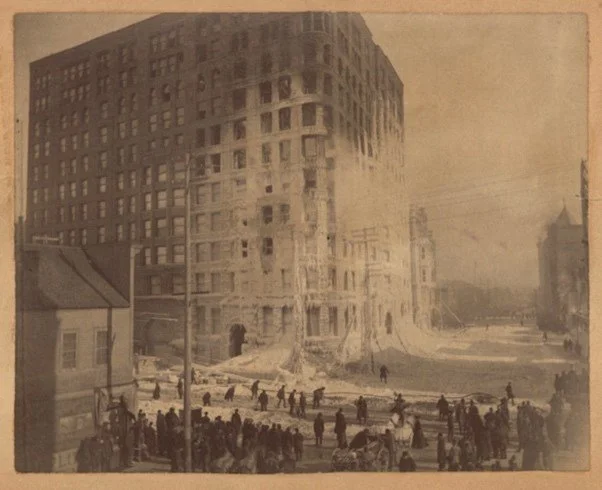
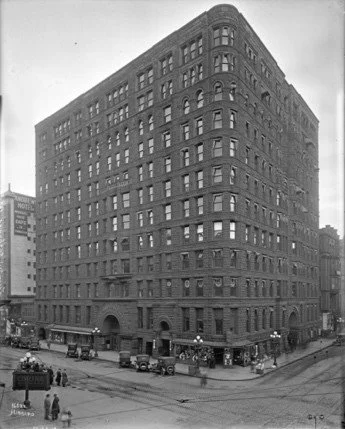
the Lumber Exchange Building was considered one of the first fireproof skyscrapers in the country.
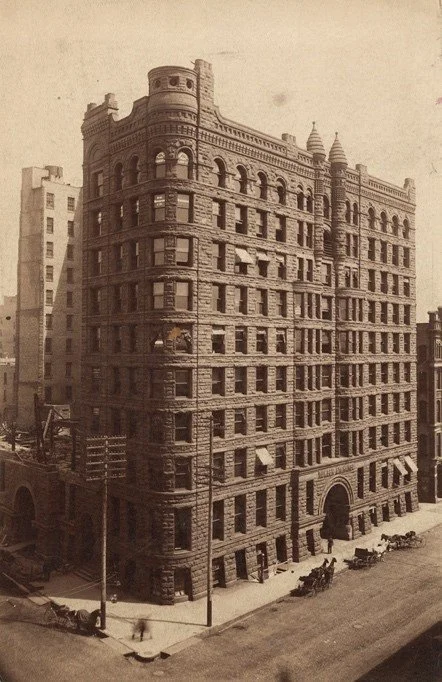
The Lumber Exchange Building was built in 1887 to house the offices of lumber distributors. The lumber industry was expanding in the late 1880s in the Upper Midwest, and a building was needed to house those engaged in this booming business.
The Lumber Exchange Building was completed as a ten-story building, which in 1885, while being designed, was considered an excessive height and “fit only to be rented to the angels.” The architectural firm of Long & Kees (Franklin B. Long and Frederick Kees) designed the building. The style is Richardsonian Romanesque and features bold massing of pink Kasota stone contrasted with lines of windows. Long & Kees worked extensively in this style and are known not only for the Lumber Exchange Building but also Minneapolis City Hall (1889), the Flour Exchange Building at 310 4th Avenue South (1893-1897), and the Masonic Temple (1888) – now the Hennepin Center for the Arts, located at Hennepin and North 6th Street.
With additional space needed, Long & Kees was hired to expand the building. The Hennepin Avenue side of the building was extended to include 13 additional bays of windows and an arched opening, matching the building entrance on South 5th Street. In addition, two floors were added. With 12 stories, the height was considered substantial enough to be considered the start of an era of ‘skyscrapers’ in Minneapolis. While today we consider a skyscraper to be much taller than a 12-story building, in the 1880s, the term was used to refer to buildings between 10 and 20 stories. At 12 stories, the Lumber Exchange Building was clearly a ’skyscraper’.
Construction costs for the two phases of the building totaled $1,200,000. Considered one the most expensive buildings at the time to be built in Minneapolis, the building had a 60-footlong swimming pool in the basement private club area, built for the lumber executives who officed in the building.
The ten-story section of the building was designed with a “slow burn” construction method: columns and beams were large enough to retain strength even if a portion of their bulk was charred or burned.
The upper two floors – five years newer – used a more modern fireproof method of protection. When completed, the Lumber Exchange Building was considered one of the first fireproof skyscrapers in the country.
This claim was put to the test when in 1891 a fire broke out in the adjacent building on South 5th Street, a paint / hardware store. The fire burned for a full 24 hours, and while the lower ten floors were partially ruined, the upper two floors were unscathed. After the fire, a skin of terra cotta sheathing was placed over the wood and iron skeleton of the building, a design and structural technique that attracted national attention.
It is the oldest high-rise building standing in Minneapolis, and is the oldest building outside of New York City with 12 or more floors.
Source: CA_DW-edits.LumberExchange-long-history-5-4-22-5-12-22
PDF (www.thedmna.org)